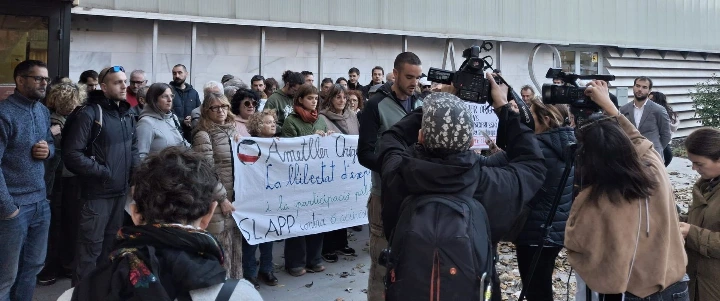
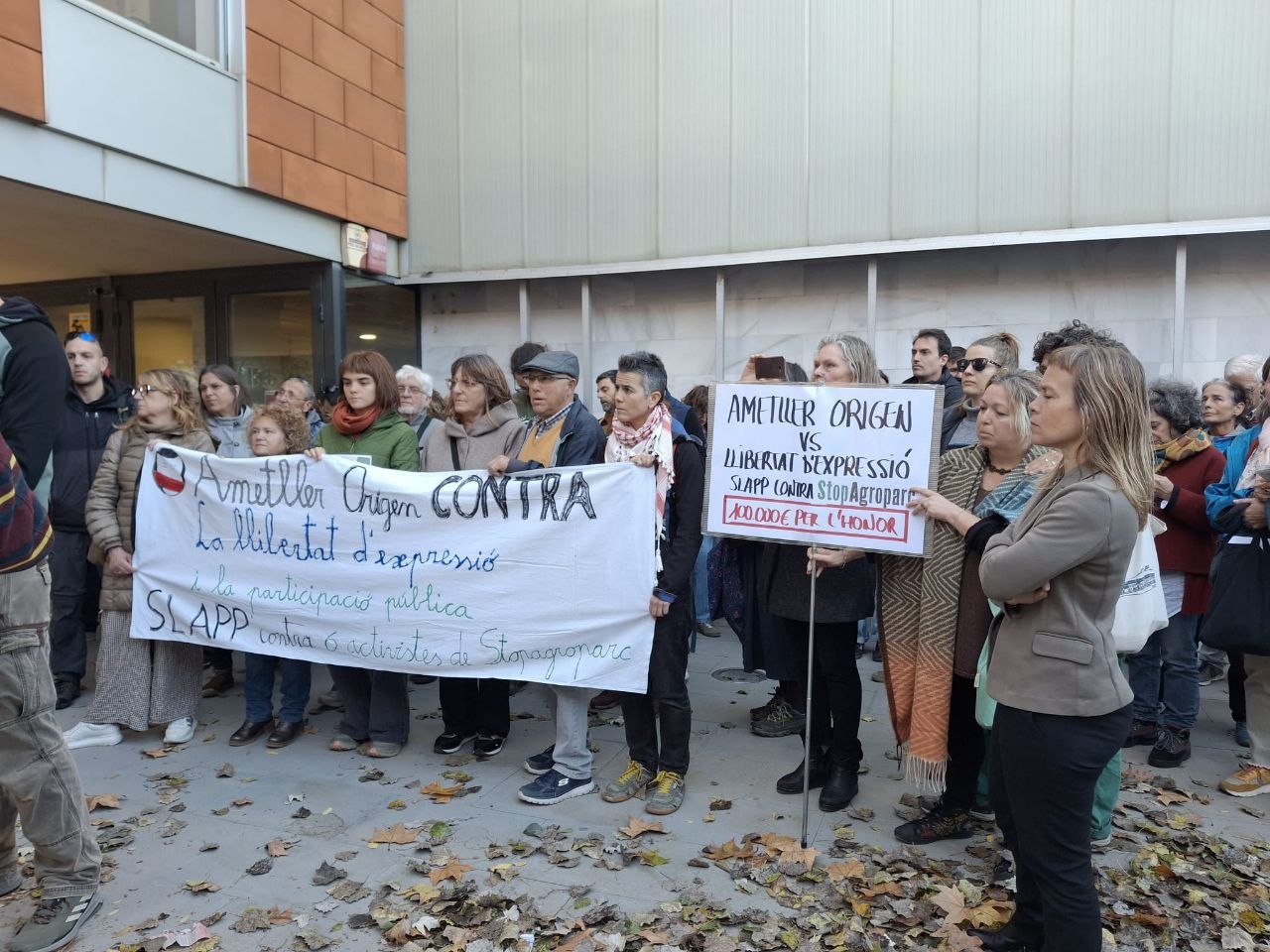
The StopAgroparc Platform warns that Ametller Origen is proceeding with a criminal complaint and also a civil lawsuit against the association Naturalistes de Gelida—one of the three entities supporting the platform— and four individuals who are already facing criminal charges. Together, the actions include a criminal complaint for the crime of defamation against six activists and a civil lawsuit for violation of the right to honour with a total claim of 215,000 euros and the withdrawal of publications.This is not an isolated conflict: it is an offensive against freedom of expression and against environmental and territorial defence.
The
Ametller Origen case revived the 2021 agro-industrial macroproject Agroparc, which would concentrate a production and distribution centre on more than a hundred hectares, partly in a protected area. The initiative reactivated StopAgroparc, which in its first phase already received support from Bosc Verd and Unió de Pagesos, and to which Naturalistes de Gelida. Since its inception, activists and entities have conducted an opposition campaign using tools of public participation: amendments to urban planning instruments, informative talks, technical reports, and, when there has been no other option, administrative litigation.
The public communication made by the StopAgroparc platform and Naturalistes de Gelida—the association that has litigated in the Courts against the urban planning instruments for the implementation of the macroproject, as the platform does not have legal personality— has always been constructive, rigorous and based on objective facts and on expert technical opinions in matters of wildlife and flora protection, urban planning, water management, mobility and law.
Via criminal
Josep Ametller, in a personal capacity, has filed a lawsuit against six activists for a crime of defamation —false attribution of criminal acts— for four sentences included in a publication from 17 October 2025 on the account of Instagram of StopAgroparc, in which the actions of the Administration were questioned. The phrases are: "Ametller Origen can bypass the law", "Despite warnings and precautionary measures, the Generalitat and the Director General of the Environment look the other way", "They continue to excavate within a protected area. Without effective authorisation. Without compensatory measures" and "A neighbour would not be allowed to build a wall. A private company is allowed to destroy a protected habitat. We wonder why not everyone is equal before the law", and subsequently, they sought support for a manifesto directed at the administrations.
The lawsuit was admitted for processing in May 2026; in July 2026, the CEO testified as an injured party, on 19 November 2026, the statements of the environmental activists as investigated to place.
Civil route
Shortly thereafter, the companies UNPASMES S.L. and Ametller Origen S.L. filed a civil lawsuit for violation of the right to honour for the entirety of the public campaign opposing the Agroparc, for damages resulting from the suspension of the construction works of the macroproject and for graffiti in the group's establishments. The group is claiming 215,000 euros in total from Naturalistes de Gelida and four activists, plus the removal of publications on social networks, blog and YouTube channel of StopAgroparc and on the social networks of the activists. The lawsuit was admitted for processing in July 2026 and, at the beginning of September, the activists submitted allegations and evidence of discharge. In the coming months, the Court will schedule the preliminary hearing.
No it is not an isolated case: litigation to intimidate activism
In their defence, the activists have argued that the actions of Ametller Origen are not an isolated phenomenon but are part of the international trend of strategic litigation against public participation (SLAPP): lawsuits designed not to win legitimate cases, but to exhaust economic and psychological resources and deter activism. The EU approved an anti-SLAPP Directive in 2024 that requires States to ensure that courts detect this phenomenon; although the transposition deadline has passed, it has not yet been transposed into the national legal system, which does not prevent courts from having to detect this type of procedure and judge accordingly.
A particularly paradigmatic case
The case is paradigmatic because it affects a business group that has built its brand on values of respect for the territory and the environment; because it attacks through a dual approach—criminal, with prison sentences, and civil, with unbearable economic claims for an environmental entity or an individual activist—; and because it aims for activists not only to limit the public communication made so far, but to refrain from continuing the critical campaign against the macroproject. Currently in Catalonia, there are other similar procedures, such as the lawsuit filed by Griñó Ecològic S.A. against GEPEC and certain activists and journalists, for uncovering a network dedicated to the illicit trafficking of urban waste from Italy. These cases cannot be analysed as a particular conflict, but as a social phenomenon and symptomatic of the response received when the activities of private companies are monitored in their actions in the territory. The rulings issued in each of these cases will generate a precedent or 'ceiling' for public participation and the freedom of expression of environmental activism, at a historic moment when this is more justified and more necessary than ever.